

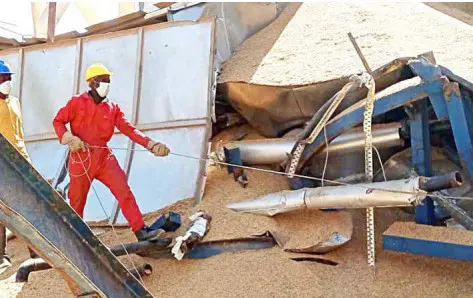
Nigeria’s much-celebrated rice revolution is facing a major reversal, with more than 90 out of the country’s 260 integrated rice mills shutting down completely over acute paddy scarcity, rising production costs and the influx of cheaper imported rice.
This comes as the National Rice Development Strategy II, launched in 2021 to accelerate investments and self sufficiency in rice production expires next month.
The programme was part of the Buhari administration’s agricultural transformation agenda, which sought to reduce dependence on food imports and conserve foreign exchange.
Nigeria had announced 75 per cent self-sufficiency in rice production in February 2023 and projected to become a net exporter of the commodity by 2026.
The progress was showcased in January 2023 when the Federal Government, the Central Bank of Nigeria, CBN, and Rice Farmers Association of Nigeria, RIFAN, unveiled what they described as the world’s largest rice pyramids in Abuja.
The pyramids, comprising one million bags of paddy, were presented as evidence of Nigeria’s growing capacity to produce enough rice for domestic consumption and eventually export the commodity.
Nigeria’s annual rice import bill, estimated at about $1 billion in 2015, was said to have fallen to approximately $18.5 million by 2021.
But the year 2025 marked the beginning of the reversal of fortune with Paddy production, which had risen to 8.5 million tonnes in 2021, recording a sharp decline to about 4.8 million tonnes, while mill capacity utilisation dropped below 30 per cent.
Industry operators told Financial Vanguard that leading integrated mills, including Umza in Kano and Stallion in Lagos, are operating below 50 per cent of their installed capacity.
Speaking to the unfolding crisis the National Chairman of the Rice Millers Association of Nigeria, RIMAN, and Chairman, Board of Trustees of the Competitive African Rice Forum for Sustainable Development, CARF-FSD, Nigeria Chapter, Mr. Peter Dama, noted the rice policy inconsistency especially the suspension of the Anchor Borrowers’ Programme (ABP), which drove the country’s rice production surge between 2015 and 2023.
The industry operators listed inadequate agricultural financing, insecurity, escalating input costs and weak supply chains as key in the derailing of the growth over the past three years.
More recently they said that 2026 has witnessed a deliberate opening of the country’s borders allowing massive importation of cheaper foreign rice especially through Seme border with Benin Republic.
They lamented that Nigerians have invested heavily in building rice mills but the government has failed to sustain the agricultural production policy needed to keep them running
Perhaps the most disturbing aspect of the current crisis is the contradiction between Nigeria’s enormous milling capacity and the shortage of locally produced paddy.
According to Dama, the country has installed rice milling capacity of approximately 7.5 million tonnes annually but currently produces only 4.1 million tonnes of paddy.
This leaves a huge gap between the capacity of the industry and the raw materials available to sustain its operations.
The operators noted cost over-run as the main factor stoking the crises as a tonne of paddy that sold for about N180,000 in 2021 now costs between N600,000 and N650,000.
Fertiliser prices, according to them, have increased from about N8,000 to N45,000, while petrol has risen from N250 to N1,400 per litre.
The input cost, according to them, has made the local rice now uncompetitive against the imported brands.
Dama said that locally milled rice at current paddy prices costs more than imported finished rice through Lagos ports.
Consequently, some farmers are abandoning rice for alternative crops such as sesame and sorghum, further worsening the shortage of paddy.
The crises, according to the operators, goes beyond the fortunes of rice mill owners to include farmers, transporters, distributors, workers and millions of households that depend on rice as a staple food.