

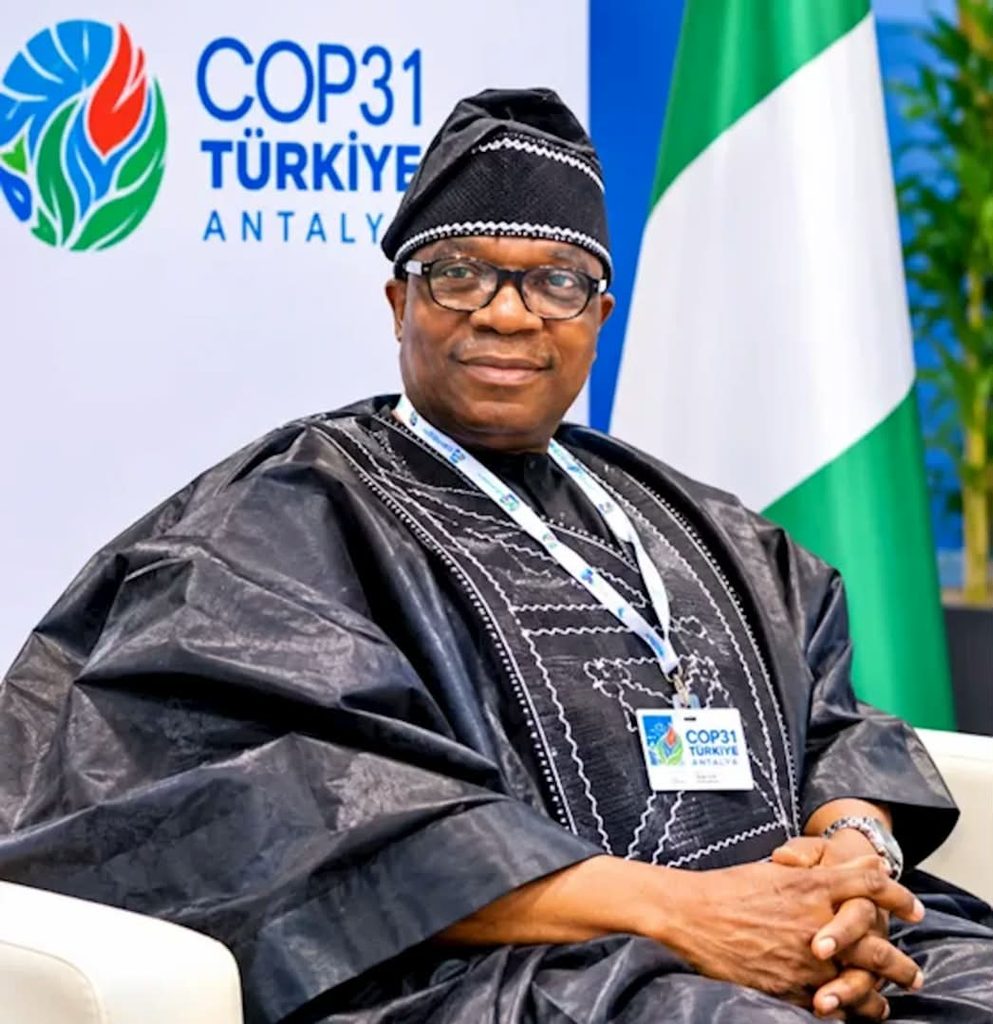
The Federal Government has reaffirmed Nigeria’s commitment to achieving net-zero emissions, insisting that the country’s transition from fossil fuels must reflect its national development priorities and should not be dictated by international partners.
The Minister of State for Foreign Affairs, Sola Enikanolaiye, said Nigeria was making progress towards cleaner energy but would not abandon its petroleum resources without adequate alternatives to protect government revenue, industrialisation, energy security and economic growth.
He spoke in an exclusive interview with newsmen on Sunday, on the sidelines of the ongoing 31st United Nations Climate Change Conference in Antalya, Türkiye, after Nigeria and the United Kingdom announced a new energy transition partnership.
Enikanolaiye said the agreement allowed Nigeria to present its position on the global shift away from fossil fuels and negotiate international support to advance its development objectives.
The minister stressed that Nigeria must participate in decisions affecting its energy future, warning against transition policies that ignored the different economic realities and development stages of countries.
He explained that the non-binding Memorandum of Understanding signed with the UK was intended to promote cooperation at different levels, including government-to-government engagements, private sector investments and partnerships with civil society organisations and host communities.
The minister said Nigeria was already diversifying its economy to reduce excessive dependence on petroleum revenues, citing developments in agriculture, technology, digital trade, financial technology and services.
He said the administration of President Bola Tinubu was pursuing a broader economic restructuring that would create additional sources of growth and revenue beyond oil and gas.
Addressing concerns that Nigeria was caught between the effects of climate change and international pressure to reduce fossil fuel production, Enikanolaiye said diplomacy remained essential to balancing competing global interests.
He cited the Russia-Ukraine war and tensions involving Iran and the United States in the Middle East as examples of geopolitical developments affecting global energy supplies and petroleum prices.
The minister also highlighted the contribution of the Dangote Petroleum Refinery to stabilising petroleum supply, saying its impact extended beyond Nigeria to the wider African market.
Enikanolaiye dismissed suggestions that Nigeria was being pressured into accepting the energy transition agenda of developed countries, insisting that the country had the diplomatic capacity to defend its interests.
He challenged international partners to demonstrate their commitment through climate financing, infrastructure development and technology transfer rather than merely advocating the abandonment of fossil fuels.
The minister also cited the Federal Government’s compressed natural gas bus programme as part of efforts to expand cleaner transportation options and reduce the pressure of energy costs on Nigerians following economic reforms.
Under the UK-Nigeria Energy Security and Transition Partnership, both countries are expected to strengthen cooperation on methane reduction, particularly in the oil and gas, agricultural and waste sectors.
Enikanolaiye said the partnership would support improved methane measurement, reporting and verification, leak detection and repair, as well as the reduction of gas flaring and venting.