

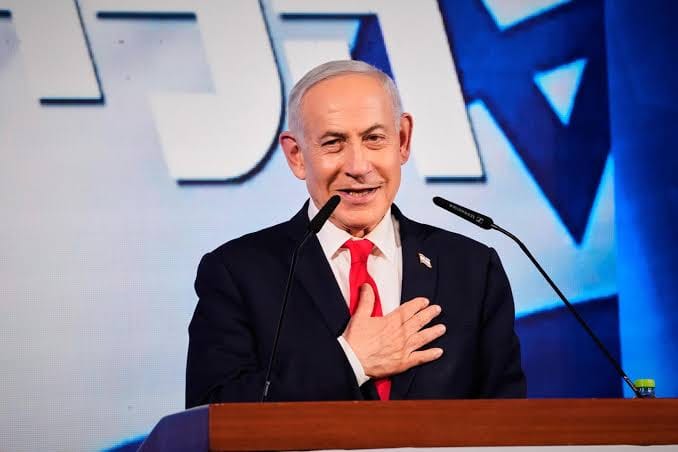
Israeli Prime Minister Benjamin Netanyahu’s political bloc has taken the lead in the country’s parliamentary election count but remains short of a majority, leaving the outcome uncertain as opposition parties consider their options for forming the next government.
With more than 66 per cent of ballots counted as of Wednesday morning, October 28, partial results placed Netanyahu’s bloc at 56 seats in the 120-member Knesset, compared with 48 seats for the opposition bloc led by former military chief Gadi Eisenkot. Arab-led parties were projected to hold 16 seats.
The figures leave Netanyahu’s bloc five seats short of the 61 required for a parliamentary majority, while the opposition would also need additional support to form a government.
The election is widely viewed as a test of Netanyahu’s leadership following the Hamas-led attacks of October 7, 2023, and the subsequent wars that reshaped Israel’s security environment and relations across the Middle East.
Netanyahu’s Likud party emerged as the largest individual party in the partial count, strengthening his position as vote counting continued.
Addressing supporters in Jerusalem, Netanyahu called for the formation of a strong right-wing national government, highlighting his administration’s military record and pledging to continue confronting Iran.
However, his rejection of a government dependent on Arab parties could complicate efforts to secure a parliamentary majority if his existing political allies fail to deliver the required numbers.
Netanyahu’s bloc includes right-wing and religious parties whose support has been central to his governing arrangements. Whether those partners can collectively secure enough seats will be critical to the next stage of negotiations.
Although his bloc is ahead in the partial count, the lead does not automatically guarantee another term. Under Israel’s proportional parliamentary system, a government must secure sufficient support in the 120-member Knesset to govern.
The performance of Arab-led parties has become one of the most significant developments in the election.
With a combined projected 16 seats, the parties could influence the balance of power if neither of the main political blocs can secure a majority independently.
Their position, however, does not guarantee that they will join a coalition or formally support either candidate for prime minister.
Netanyahu has rejected relying on Arab parties to form a government, while disagreements within the opposition over cooperation with Arab lawmakers could also complicate coalition negotiations.
Arab-led parties could potentially support a minority government on parliamentary votes without joining it formally, but such an arrangement would require political agreements that have yet to emerge.
Their final seat tally and the positions they adopt could therefore become decisive in determining who forms Israel’s next government.
The election recorded a turnout of 77.7 per cent, the highest since 1999, according to figures reported by Israeli media. Turnout among Israeli military personnel reached 79.9 per cent.
The strong participation came amid continuing divisions over national security, the government’s handling of the October 7 attacks and the wars that followed.
For Netanyahu, the election offered an opportunity to retain power after a period marked by major security challenges and intense domestic political debate. For his opponents, it provided an opportunity to seek a change in leadership and a different approach to governance.
The partial results suggest that neither side has yet secured an undisputed parliamentary majority, despite Netanyahu’s bloc moving ahead in the count.